

Diagnosing a Traumatic Brain Injury
There are at least ten separate criteria for diagnosing TBIs. Symptoms commonly include:
- vomiting or headache
- lethargy or confusion
- paralysis, coma, or loss of consciousness
- dilated pupils or vision changes
- cerebrospinal fluid (CSF) appearing from the ears or nose
- droopy eyelid or facial weakness
- loss of bowel control or bladder control
- difficulty swallowing
- ringing in the ears, or changes in hearing and balance
- breathing problems, or slow breathing rate with an increase in blood pressure
- slow pulse
- cognitive difficulties, and inappropriate emotional responses
- speech difficulties
- body numbness or tingling
A TBI is generally defined as a sudden brain injury caused by a blow to the head, a penetrating head injury, blast-induced injury, or when the brain is shaken within the skull.
The Glasgow Coma Scale (GCS)
The GCS is a widely recognized initial tool for assessing TBIs in trauma patients. The GCS classifies TBIs as mild, moderate, or severe. The GCS was developed in 1974 by Graham Teasdale and Bryan Jennett to assess the level of consciousness of a TBI patient. The GCS assesses a TBI patient’s eye response, verbal response, and body movement response.
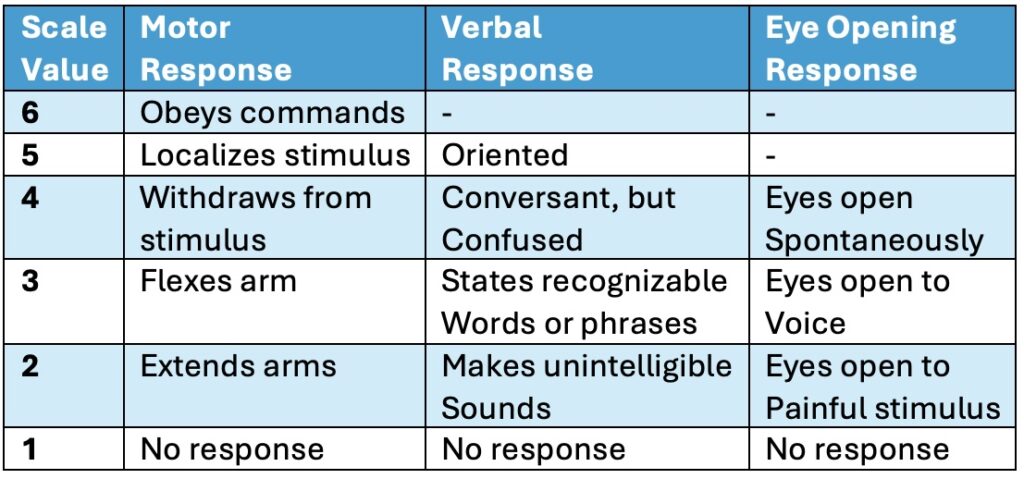
A GCS of 13 to 15 is a mild TBI and is associated with brief loss of consciousness and normal brain imaging results. A GCS of 9 to 12 is a moderate TBI and is associated with loss of consciousness for 1 to 24 hours and abnormal brain imaging results. A GCS score of 3 to 8 is a severe TBI with loss of consciousness for more than 24 hours and abnormal brain imaging results.
Neuroimaging
Neuroimaging is an important tool for identifying patients with TBIs. Rapid utilization of neuroimaging helps distinguish patients who need emergency neurosurgical intervention from those patients who require only monitoring. CT or CAT scan is the standard for radiological assessment of a patient with a suspected TBI. A CT scan can detect blood in and around the brain and fractures. Conventional x-rays may also help evaluate patients with mild neurological issues. MRIs are not commonly used for the initial assessment of TBIs because it takes longer to perform an MRI than a CT. However, after a patient is stabilized, an MRI may help identify brain lesions undetected by CT scans.
Blood Test
The Banyan Brain Trauma Indicator (BTI) is a blood test focusing on blood proteins that indicate concussion or mild TBI.
Neuropsychological Examination
A neuropsychological examination involves performing cognitive tasks that help assess memory, concentration, information processing, executive functioning, reaction times, and problem-solving. Many neuropsychological tests are highly subjective and susceptible to manipulation by both the patient and the test administrator. Factors affecting neuropsychological test results include test selection, conditions under which the test was administered, the plaintiff’s use of medication, the establishment of the plaintiff’s baseline, selection of normative data used to compare the plaintiff’s test data, and the neuropsychologist’s method of interpretation of raw test data. Nevertheless, neuropsychological testing is routinely used to assess scope and extent of TBIs.
Defending Traumatic Brain Injury Claims: Part I of III
Defending Traumatic Brain Injury Claims: Part III of III
 M. Jansen Voss has developed a diverse defense litigation and appellate practice in both state and federal courts in Alabama and Mississippi. He represents a wide range of businesses, governmental entities, and individuals in complex personal injury and wrongful death lawsuits, as well as business disputes and breach of contract matters.
About Christian & Small
Christian & Small LLP represents a diverse clientele throughout Alabama, the Southeast, and the nation with clients ranging from individuals and closely held businesses to Fortune 500 corporations. By matching highly experienced lawyers with specific client needs, Christian & Small develops innovative, effective, and efficient solutions for clients. With offices in Birmingham, metro-Jackson, Mississippi, and the Alabama Gulf Coast, Christian & Small focuses on the areas of litigation and business, is a member of the International Society of Primerus Law Firms, and is a Mansfield Rule™ Participating Law Firm. Our corporate social responsibility program is focused on education, and diversity is one of Christian & Small’s core values.