2024 saw several important decisions rendered by the Supreme Court of the United States. In this 5 part series, we take a look at some key decisions and the cases that led to those decisions. These are the case summaries decided by SCOTUS that most affect our clients and the courts in which we practice. Case summaries were prepared by Christian & Small summer law clerks Katie Applebaum and Eric Posas along with Partners Sharon D. Stuart and Bill D. Bensinger.
Part 2: Decisions Impacting Social Media
Social Media
Lindke v. Freed, 144 S. Ct. 756 (decided 3/15/24) – social media, Section 1983 claim
In Lindke v. Freed, the Court clarified that a public official's social media posts can be attributed to the government only if the official possessed authority to speak on a matter and exercised such authority when posting on his social media account.
James Freed created a private Facebook account during his college career. When Freed, an avid Facebook user, began to reach the platform's 5,000-friend limit, he converted his profile to a public page. Freed continued to use his Facebook like before, posting about his personal life and sharing activities such as the daddy-daughter dance he and his daughter attended. In 2014, Freed was appointed city manager of Port Huron, Michigan, and he updated his Facebook to reflect the new job. As before his appointment, Freed operated the Facebook page himself and primarily posted about his public life, however, he also posted information related to his job such as visiting local high schools and starting reconstruction on the city's boat launch. Freed's readers would frequently comment on his post, and he would often reply to, as well as delete, the comments he found "derogatory" or "stupid."
After the COVID-19 pandemic began, Freed posted pictures of his family, but also information related to his job, including the steps being taken by the city during that time. Kevin Lindke, unhappy with the city's approach to the pandemic, started commenting on Freed's page and would express his dislike of the city's approach. Freed would delete Lindke's negative comments but ultimately blocked him. Once blocked, Lindke could see Freed's posts but could no longer comment on them.
Lindke sued Freed under 42 U.S.C. § 1983, alleging that Freed violated his First Amendment rights. The District Court granted summary judgment to Freed on the grounds that only state action can give rise to liability under § 1983, and that Lindke's claim depended on whether Freed acted in a "private" or "public" capacity. The Court concluded that Freed's Facebook was operated in a private capacity due to the absence of "government involvement" with his account and lack of posts detailing official business.
The Sixth Circuit affirmed the District Court's ruling that Freed's Facebook was operated in a private manner and was not applicable to § 1983. The court stated that Freed's Facebook could not rise to the level of state action, as Freed was not performing a direct duty of office and could have used his social media account "without the authority of office." The Sixth Circuit's approach to state action in the social-media context differs from that of the Second and Ninth Circuits, which focus less on the connection between the official's authority and the account and more on whether the account's appearance and content look official.
The Supreme Court granted certiorari to clarify this issue. The Court held that the state-action doctrine requires Lindke to show that Freed (1) had actual authority to speak on behalf of the State on a particular matter, and (2) purported to exercise that authority in the relevant posts. Section 1983 provides a cause of action against a person "who, under color of any statute, ordinance, regulation, custom, or usage, of any State" deprives someone of a federal constitutional or statutory right. Thus, the § 1983 claimant must show actions attributable to a state, not those of a private person. The Court clarified that state officials retain their own First Amendment rights to speak about their jobs as private citizens. Because the Sixth Circuit applied a different test, the Court vacated its judgment and remanded the case.
This decision establishes the grounds determining whether a social media account rises to the level of state action and sets out various factors to consider in determining when a social media account is subject to First Amendment limitations. Although it is not an ironclad defense, a public official can label his account as a personal page or include a disclaimer to abate the presumption that the posts are of an official nature. To avoid potential liability, the public official should ensure that his personal account is limited to personal posts or that his comments concerning government activities are completely unrelated to his position. Public officials should also be wary of blocking someone from a social media page containing official posts, as such an act could still present a First Amendment issue.
O’Connor-Ratcliff v. Garnier, 601 U.S. 2024 (decided 3/15/24) – social media, First Amendment
O'Connor-Ratcliff v. Garnier, decided with Lindke v. Freed, reinforces the test for determining whether a public official's personal and public social media accounts can be considered "state action."
In 2014, Michelle O'Connor-Ratcliffe and T.J. Zane created public Facebook pages to promote their campaigns for the election to the Poway Unified School District (PUSD) Board of Trustees. Both O'Connor-Ratcliffe and Zane (hereinafter "Trustees") had personal Facebook accounts for family and friends, but they continued to use their public pages after they won the election to post PUSD-related content. This content included board-meeting recaps, application solicitations for board positions, and public safety updates. Christopher and Kimberly Garnier, whose children attended PUSD schools, often criticized the board of trustees and posted lengthy comments repetitively on the Trustees' public social media pages. The Trustees initially deleted the Garniers' comments before blocking them altogether.
The Garniers sued the Trustees under 42 U.S.C. § 1983, seeking damages and declaratory and injunctive relief for the alleged violation of their First Amendment rights. At summary judgment, the District Court granted the Trustees qualified immunity as to the damages claims but allowed the case to proceed on the merits on the ground that the Trustees acted "under color of" state law when they blocked the Garniers. The Ninth Circuit affirmed the District Court holding that the plaintiffs satisfied the § 1983's state-action requirement because there was a "close nexus between the Trustees' use of their social media pages and their official positions." The Ninth Circuit found state action based on the official "appearance and content" of the Trustees' public pages.
The Supreme Court granted certiorari in this case, as well as in Lindke v. Freed, to resolve a circuit split about how to identify state action in the context of public officials using social media. The Supreme Court held that the state-action doctrine requires the party challenging the suppression of speech to show that the party suppressing the speech (1) had actual authority to speak on behalf of the State on a particular matter, and (2) purported to exercise that authority in the relevant posts. Because the Ninth Circuit's approach was different from the Lindke approach, the Supreme Court vacated the judgment and remanded the case.
This decision affirms the Lindke standard and helps establish the direct line in which a plaintiff can bring a case alleging suppression of free speech by an entity through state action. This will also allow public officials to understand whether actions taken on their social media account give rise to state action and whether they may be liable under the First Amendment for suppression of speech.
Moody v. NetChoice, 603 U.S. 707 / NetChoice v. Paxton, 603 U.S. 707 (both delivered in Moody opinion) (decided 7/1/24) – Florida and Texas content moderation restrictions
In these cases, the Supreme Court vacated the judgment of the Fifth and Eleventh Circuits because both courts incorrectly performed the requisite facial analysis when determining whether content-moderation restrictions violate the First Amendment.
In 2021, Florida and Texas enacted statutes regulating internet platforms, including large social media companies such as Facebook and YouTube. The states' laws differ in the entities they cover and the activities they limit, but both contain content-moderation provisions that restrict covered platforms' choices about whether and how to display user generated content to the public. Both states' statutes also include individualized-explanation provisions, requiring platforms to give reasons for content-moderation choices.
Soon after Florida and Texas enacted these regulatory statutes, NetChoice, LLC and the Computer & Communications Industry Association (collectively "NetChoice"), trade associations whose members include Facebook and YouTube, brought facial First Amendment challenges against the two laws. District courts in both states entered preliminary injunctions, halting the laws' enforcement. Each court held that the suit is likely to succeed because the statute infringes on the constitutionally protected "editorial judgment" of NetChoice's members about what material they will display.
The Eleventh Circuit upheld the injunction of Florida's law, holding that the state's restrictions on content moderation trigger First Amendment scrutiny under the Supreme Court's decisions protecting "editorial discretion." The court concluded that the content-moderation provisions are unlikely to survive because a state has no legitimate interest in counteracting "private censorship" in a preferred direction.
The Fifth Circuit disagreed with the preliminary injunction of the Texas statutes and reversed the lower court's judgment. The Fifth Circuit held that platform content-moderation activities are not "speech" and do not implicate the First Amendment. The court further held that the statute's individualized explanation provisions would likely survive, even assuming the platforms were engaged in speech.
The Supreme Court granted certiorari to resolve the split between the Fifth and Eleventh Circuits. The Court held that a state "cannot advance some points of view by burdening the expression of others" and that giving the government power to moderate content would enable it to control the expression of ideas, promoting those it favors and suppressing those it does not. The Court further held that the First Amendment protects everyone from suppression of speech, and that the Fifth Circuit would get wrong at least one input into the facial analysis. The
Supreme Court vacated the judgments of the Courts of Appeals for the Fifth and Eleventh Circuits and remanded the cases for further proceeding consistent with the opinion.
This decision allows social media platforms and other entities to retain their rights of free speech and avoid having to abide by different state laws on what content they can and cannot allow on the platform.
Murthy v. Missouri, 603 U.S. __ (decided 6/26/24) – social media, First Amendment
The Court determined that the plaintiffs lacked Article III standing to bring a First Amendment violation claim after the alleged censoring of their social media posts; therefore, the Court denied injunctive relief.
The plaintiffs consisted of two states and five individual social media users, and the Government individuals and agencies were the defendants in this case. The individual plaintiffs are three doctors, the owner of a news website, and a healthcare activist who allege that various platforms removed or demoted their COVID-19 or election-related content between 2020 and 2023. Missouri and Louisiana claim that the platforms have suppressed the speech of state entities and officials, as well as their citizens' speech. Even though the platforms restricted the plaintiffs' content, the plaintiffs maintain that the Federal Government censored their posts. Plaintiffs filed suit against dozens of executive branch officials and agencies, alleging that they pressured the platforms to censor the plaintiffs' speech in violation of the First Amendment.
The District Court issued a preliminary injunction holding that officials at the White House, the Surgeon General's Office, the CDC, the FBI, and CISA likely "coerced" or significantly encouraged the platforms "to such extent that their content-moderation decisions should be deemed the decisions of the Government." The court enjoined those agencies and other unnamed officials from taking actions "for the purpose of urging, encouraging, pressuring, or inducing the removal, suppression, or reduction of content containing protected free speech posted on social-media platforms."
The Fifth Circuit affirmed in part and reversed in part. The court held that the individual plaintiffs had Article III standing to seek injunctive relief, reasoning that the social-media companies had suppressed the plaintiffs' speech in the past and were likely to do so again in the future. According to the court, both injuries were traceable to government-coerced enforcement of the platform's policies. The court held that the states had standing, both because the platforms had restricted the posts of individual state officials and because the states have the "right to listen" to their citizens on social media. The court held that White House officials, the Surgeon General's office, and the FBI coerced and significantly encouraged the platforms to moderate content.
The federal agencies and officials applied to the Supreme Court for emergency relief. In a 6-3 opinion, the Supreme Court stayed the injunction, treated the application as a petition for a writ of certiorari, and granted the petition. Justice Barrett, writing for the majority, stated that the plaintiffs must show a substantial risk that, in the near future, at least one platform will restrict the speech of at least one plaintiff in response to the actions of at least one Government defendant. The plaintiffs carried the heavy burden of showing that at least one defendant pressured a platform to censor a topic before that platform suppressed the plaintiff's speech on that topic. The plaintiffs requested the court to conduct a review of years-long communications between dozens of federal officials, across different agencies, with different social media platforms, about different topics, without any concrete link between their injuries and the defendants' conduct. The Court concluded that the plaintiffs failed to link past social-media restrictions and the defendants' communications with the platforms, nor did they cite any past restrictions likely traceable to the Government defendants. Because the plaintiffs could not assert an injury that was sufficiently "concrete and particularized," the Court denied Article III standing. The Supreme Court reversed the judgment of the Fifth Circuit and remanded the case for further proceedings consistent with the opinion.
As this situation is prevalent in today’s media world, this decision will ensure that plaintiffs preparing to file an action against a government entity must be able to show definitive proof that this entity coerced the social media platforms to engage in conduct violative of the First Amendment. The court system is not the place to begin searching for proof on such a serious and broad claim. This decision also affords protection to government actors to shield them from possible First Amendment liability, especially due to the strict threshold showing required of plaintiffs to prove Article III standing.
Part 1: Federal Arbitration/Federal Agency
Part 2: Bankruptcy/SEC Sarbanes Oxley
 Sharon D. Stuart is a founding partner of Christian & Small and has been with the firm since 1993. She devotes her practice to civil trial work and arbitration. She focuses on complex commercial and insurance litigation, and she handles a variety of pharmaceutical and medical device products liability litigation as national, regional or local counsel. Sharon’s trial experience includes a wide range of business tort claims, contract disputes, commercial and insurance fraud and bad faith suits, and wrongful death cases. She has defended dozens of class action lawsuits in areas as diverse as product liability/toxic tort, financial products, insurance, and employment law.
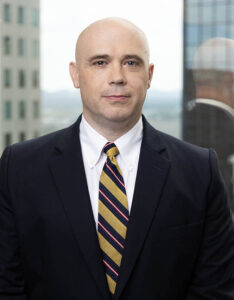 Bill D. Bensinger focuses his practice on commercial dispute litigation, bankruptcy and restructuring litigation. He represents creditors, franchisors, landlords, unsecured creditors’ committees and financial institutions in a wide variety of matters, including preference and avoidance actions, workout transactions and insolvency matters. Bill represents franchisors in bankruptcy, including matters concerning the assumption of franchise agreements, and represents landlords in bank matters concerning the assumption of commercial leases.
Contributors Katie Applebaum and Eric Posas, Christian & Small Summer Law Clerks
About Christian & Small
Christian & Small LLP represents a diverse clientele throughout Alabama, the Southeast, and the nation with clients ranging from individuals and closely held businesses to Fortune 500 corporations. By matching highly experienced lawyers with specific client needs, Christian & Small develops innovative, effective, and efficient solutions for clients. With offices in Birmingham, metro-Jackson, Mississippi, and the Alabama Gulf Coast, Christian & Small focuses on the areas of litigation and business, is a member of the International Society of Primerus Law Firms, and is a Mansfield Rule™ Certified Plus Law Firm. Our corporate social responsibility program is focused on education, and diversity is one of Christian & Small's core values. Please visit www.csattorneys.com for more information.
No representation is made that the quality of legal services to be performed is greater than the quality of legal services performed by other lawyers.