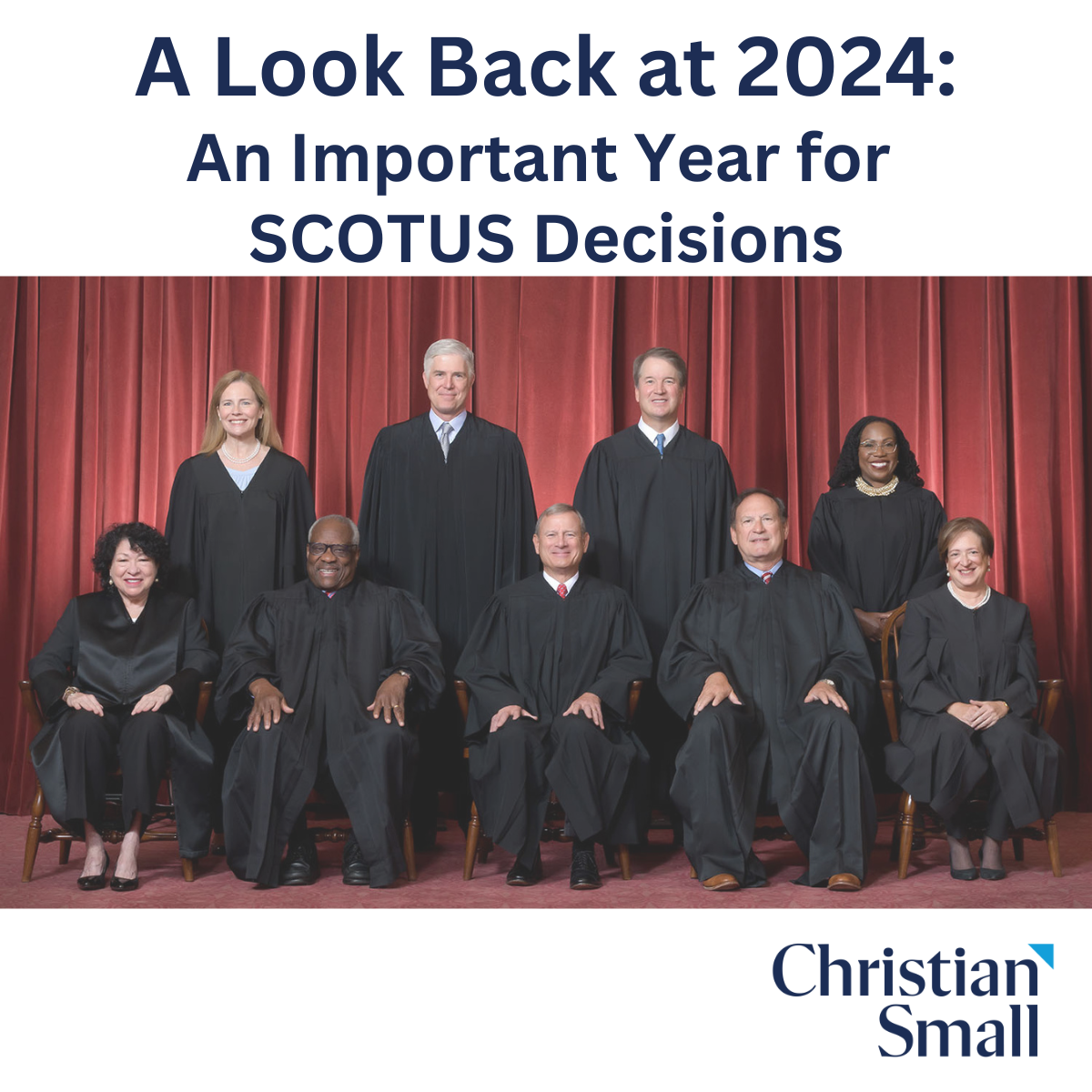
2024 saw several important decisions rendered by the Supreme Court of the United States. In this 5 part series, we take a look at some key decisions and the cases that led to those decisions. These are the case summaries decided by SCOTUS that most affect our clients and the courts in which we practice. Case summaries were prepared by Christian & Small summer law clerks Katie Applebaum and Eric Posas along with Partners Sharon D. Stuart and Bill D. Bensinger.
Part 1: Decisions Impacting the Federal Arbitration Act, Federal Agency Power, and Administrative Law
Federal Arbitration Act
Bissonnette v. LePage Park St., LLC, 601 U.S. 246 (decided 4/12/24) – FAA exemption for employees in interstate transportation
In Bissonnette v. LePage Bakeries, the Supreme Court considered the transportation exemption under § 1 of the Federal Arbitration Act (FAA). The Court held that whether an employee is considered exempt is not dependent on industry, but rather the role and function of the employee.
Plaintiffs Neal Bissonnette and Tyler Wojnarowski worked as distributors for Flowers Foods, Inc. As franchisees, Bissonnette and Wojnarowski not only picked up Flowers products from warehouses and carried the products to local shops, but also advertised the products, found new locations for the sale of goods, and stocked goods in the stores. To purchase the rights to their territories, Bissonnette and Wojnarowski signed Distributor Agreements with Flowers. These contracts incorporated Arbitration Agreements that required "any claim, dispute, and/or controversy" to be arbitrated under the Federal Arbitration Act (FAA), 9 U.S.C. § 1.
In 2019, Bissonnette and Wojnarowski filed a class action against Flowers, claiming that the company underpaid them in violation of state and federal law. Flowers moved to dismiss or to compel arbitration under the FAA, arguing that the contracts required the distributors to arbitrate their claims individually. Bissonnette and Wojnarowski countered that they were exempt under § 1 of the FAA because they classified as "transportation workers." The District Court dismissed the case in favor of arbitration, explaining that Bissonnette and Wojnarowski acted under a "much broader scope of responsibility" than what is usually required of a "transportation worker." The Second Circuit affirmed on the alternative ground that Bissonnette and Wojnarowski "are in the bakery industry," and not the "transportation industry."
In a 9-0 decision, the Supreme Court vacated the judgment of the Second Circuit, finding that there is no requirement that a worker must be employed at a company within the transportation industry to be exempt under § 1 of the FAA. The Court reinforced the reading of § 1 to include "transportation workers" who played a "necessary role in the free flow of goods," regardless of the industry in which they work. The ejusdem generis link between "seamen" and "railroad employees" are connected by what they do, not for whom they work. The Court did not consider other arguments raised below, including that Plaintiffs were not "transportation workers," nor were they "engaged in foreign or interstate commerce" within the meaning of § 1.
Although the Court denied Flowers' argument that this reading of § 1 would lead to a floodgates issue and frivolous litigation, it is likely that the broadened exemption for “transportation workers” could create challenges in application. Workers do not have to work in the transportation industry to claim exemption under § 1; rather, those who are simply involved in transporting goods may have a greater chance of escaping arbitration agreements. Although the Court’s holding is narrow and does not greatly expand the scope of the transportation worker exemption, employers who use employee arbitration clauses need to be familiar with the decision in order to defend against plaintiff-employees’ attempts to avoid arbitration.
Notably, however, Bissonnette left several unanswered questions. The Supreme Court did not answer what it means to be "engaged in foreign or interstate commerce," nor did it address whether the petitioners in Bissonnette qualified under the exemption.
Coinbase, Inc. v. Suski, 602 U.S. __ (decided 5/23/24) – arbitration agreement versus delegation clause
The Supreme Court held that the judiciary, rather than an arbitrator, must decide the question of arbitrability when parties engage in conflicting contracts.
The parties in this case executed two contracts: first, a User Agreement contract containing an arbitration provision with a delegation clause; second, a contract detailing the Official Rules of a sweepstakes. The User Agreement's Arbitration Agreement provided in relevant part: "All such matters shall be decided by an arbitrator and not by a court or judge." The Court admitted that this Arbitration Agreement "quite clearly" sends to arbitration disputes between Coinbase, Inc. and its users, including disputes about arbitrability. However, the parties agreed to a second contract containing a forum selection clause, which provided that California courts "shall have sole jurisdiction of any controversies" regarding the sweepstakes promotion.
The issue of arbitrability arose after respondents brought suit against Coinbase for violation of California's False Advertising Law, Unfair Competition Law, and Consumer Legal Remedies Act. Coinbase moved to compel arbitration, invoking the User Agreement and its delegation clause. The District Court denied Coinbase's motion and reasoned that the Official Rules superseded the User Agreement; therefore, the forum-selection clause controlled, and the parties' sweepstakes-related dispute was not subject to arbitration. The Ninth Circuit affirmed.
The Court determined that judges, not arbitrators, should decide arbitrability where there are two conflicting contracts. Justice Gorsuch cited traditional contract principles that state that the court must answer the question of whether the parties agreed to send the given dispute to arbitration. Because the parties disputed whether there was an agreement to arbitrate, traditional contract principles hold that a judge must decide the issues, even those over arbitrability. The Court rejected severability and policy arguments offered by Coinbase.
It is important to note that this decision is narrow and dependent on the circumstances of this case. The Court reaffirmed the general rule that "where parties have agreed to only one contract, and that contract contains an arbitration clause with a delegation provision, then absent a successful challenge to the delegation provision, courts must send all arbitrability disputes to arbitration." This ruling underscores the importance of including consistent dispute-resolution clauses in multiple contracts between the same parties.
Smith v. Spizzirri, 601 U.S.__ (decided 5/16/24) – FAA requires stay versus dismissal
The Supreme Court ruled that under § 3 of the Federal Arbitration Act (FAA), courts are required to issue a stay of the court proceeding pending arbitration when it is requested, and the court lacks discretion to dismiss the suit.
Petitioners were former delivery drivers for an on-demand delivery service operated by respondents. They brought suit under Arizona state and federal employment laws, alleging that respondents failed to pay required wages and benefits. Respondents removed the case to federal court and moved to compel arbitration and dismiss the suit. The District Court issued an order compelling arbitration and dismissed the case without prejudice, citing Circuit precedent that gave district courts the option to either stay the action or dismiss it outright under § 3. The Ninth Circuit affirmed.
The Supreme Court reversed, finding that the court does not have discretion to dismiss the suit on the basis that all claims are subject to arbitration if a party has requested a stay of the court proceeding pending arbitration. Justice Sotomayor emphasized Congressional use of the word "shall," noting that it "creates an obligation impervious to judicial discretion." Such plain statutory text requires a court to stay the proceeding and leaves no room for judicial discretion. The Court also held that "stay means stay," meaning that the term translates as a "'temporary suspension' of legal proceedings, not the conclusive termination of such proceedings."
In reversing the Ninth Circuit's judgment, the Supreme Court resolved a Circuit split relevant to the power of judges to dismiss cases. Once a party requests a stay of the court proceedings pending arbitration under § 3 of the FAA, judges are required to grant the stay, regardless of whether the court determines that all of the claims raised in the action are subject to arbitration. This opinion overrules Ninth Circuit precedent allowing judges to dismiss cases with arbitrable issues.
Federal Agency Power / Administrative Law
Loper Bright v. Raimondo, 144 S.Ct. 2244 and Relentless, Inc. v. Department of Commerce, 144 S.Ct. 325 (decided 6/28/24) – overruled Chevron
One of the most consequential and controversial cases of the 2024 term, Loper Bright v. Raimondo and its companion case, Relentless, Inc. v. Department of Commerce, overruled Chevron deference and greatly reduced agency power, by requiring judges to give statutes their best reading.
Under the doctrine laid out in Chevron U.S.A., Inc. v. Natural Resources Defense Council, Inc., 467 U.S. 837 (1984), courts were sometimes required to defer to "permissible" agency interpretation of the statutes that those agencies administered. The Chevron test included two steps. First, a reviewing court had to assess "whether Congress has directly spoken to the precise question at issue." Second, if the court determined the statute was silent or ambiguous with respect to the issue, Chevron required deference to the agency's interpretation if it was "based on a permissible construction of the statute." These interpretations often skewed in the government's favor.
Congress passed the Magnuson-Stevens Fishery Conservation and Management Act (MSA) in 1976 intending to provide for the management of marine fisheries in United States waters and to combat overfishing. The act allowed the National Marine Fisheries Service (NMFS), a subsidiary agency of the United States Department of Commerce, to require fishing vessels to carry federal observers on board. Issues arose between the NMFS and local fisheries on the East Coast when the New England Council (NEC) aimed to require the fishing industry to pay the costs of additional monitoring.
Loper Bright Enterprises is a New Jersey-based herring fishery operating in the waters of New England. Loper Bright brought suit in the United States District Court for the District of Columbia, alleging that the MSA did not authorize the NMFS to require industry-funded monitoring of herring fisheries. The District Court found that the MSA unambiguously allows such funding and concluded in favor of the Government at the first step of Chevron. The D.C. Circuit affirmed, concluding that the language of the MSA was not completely unambiguous but that the NMFS reasonably interpreted the statute.
The Court considered Relentless, Inc. v. Department of Commerce as a companion case to Loper Bright, as the issues arose from the same statute and agency interpretation. The owners of fishing vessels, Relentless Inc., Huntress Inc., and Seafreeze Fleet LLC challenged the National Marine Fisheries Service (NMFS)'s decision to shift the at-sea monitoring cost onto the fishery industries on the East Coast. The District Court deferred to NMFS's unambiguous interpretation of the MSA and thus granted summary judgment to the Government. The First Circuit affirmed under Chevron guidance.
The Supreme Court granted certiorari to determine whether Chevron should be overruled outright or limited in scope. Chief Justice Roberts wrote the majority opinion, which held that the Administrative Procedures Act (APA) mandated the courts to decide whether "the law means what the agency says." The Court concluded that Congress "expects courts to handle technical statutory questions," and that interested parties can submit amicus briefs for additional input. Roberts also clarified that the weaker Skidmore deference is still an avenue to consider agency interpretation and that prior decisions under Chevron are not overturned by this decision. As for the specifics of the Loper Bright case, the Court found that the MSA did not authorize officials to create industry-funded monitoring requirements.
The Court has faced critiques of this decision, especially from specialized organizations who are concerned with judicial ability to handle the technicality of agency statutes. However, this decision is considered a win for industries, including insurance, as it balances the power between regulated entities and agencies. Under Chevron, the agencies' interpretation and judgment effectively ruled. Now, the judiciary will have the ability to consider whether the agencies' interpretation is viable and to determine the appropriate scope of regulatory authority.
Ohio v. Environmental Protection Agency, 603 U.S. 279 (decided 6/27/24) – Federal Emission Reduction Rule violates Administrative Procedures Act
The Supreme Court blocked the EPA from enforcing its "good neighbor" rule of the Clean Air Act requiring 23 states to reduce air pollution.
In 2015, the Environmental Protection Agency (EPA) set new air-quality standards for ozone pollution under the Clean Air Act's "good neighbor" provision. This provision requires "upwind" states to migrate emissions that could affect air quality in "downwind" states. The "good neighbor" provision also required states to submit plans, called State Implementation Plans (SIPs), detailing their ability to meet these standards. However, the EPA rejected the plans submitted from 21 states for proposing no changes and reprimanded two states that had failed to submit plans by publishing a federal plan that mandated more effective control. The federal plan, called a Federal Implementation Plan (FIP), required the states to adopt commonly used controls by 2026 and to utilize an existing emissions trading program among the 23 affected states.
States, companies, and trade associations sought injunctions from the court to temporarily block the EPA's rule. A dozen states initiated a lawsuit against the EPA for the rejection of their emission plans. Following criticism of the FIP, the EPA announced that jurisdictions could "drop out" without changing the application of the FIP to other states. Over time, courts stayed 12 of the SIP disapprovals, meaning that the EPA could not apply its FIP to those states. A few remaining states challenged the FIP in the D.C. Circuit, arguing that EPA's decision to apply the FIP after other states had dropped out was "arbitrary" or "capricious." They asked the court to stay any effort to enforce the FIP against them while their appeal unfolded. The D.C. Circuit denied relief, and the Supreme Court granted certiorari.
In a 5-4 decision, the Supreme Court granted the applications for a stay pending the disposition of the applicants' petition for review in the D.C. Circuit. Writing for the majority, Justice Gorsuch upheld the test for deciding an application for a stay: the Court asks (1) whether the applicant is likely to succeed on the merits, (2) whether it will suffer irreparable injury without a stay, (3) whether the stay will substantially injure the other parties interested in the proceedings, and (4) where the public interest lies. Nken v. Holder, 556 U.S. 418, 434. The Court decided that the applicants are likely to prevail on their arbitrary-or-capricious claim and thus are entitled to a stay. The agency must offer a "satisfactory" explanation for its action to avoid authorizing an "arbitrary" or "capricious" action. The applicants are likely to prevail on their argument that EPA's final rule was not "reasonably" or "satisfactorily" explained because the EPA offered no response to valid critiques by commentors.
The Court's ability to grant stays significantly abates the power of the agencies, especially when the agency did not proffer a reasonable explanation for the action. This is one of several cases this term that represents a shift toward judicial oversight over federal agencies. A majority of the current nine Justices have shown skepticism about administrative agencies and their stringent regulations. It is likely that this Court will continue to suppress agency power.
Corner Post, Inc. v. Federal Reserve, 603 U.S. 799 (decided 7/1/24) – when does an Administrative Procedures Act claim “first accrue”?
The Supreme Court held that an Administrative Procedures Act (APA) claim does not accrue for purposes of §2401(a)'s 6-year statute of limitations until the plaintiff is injured by final agency action, rather than the date the regulation was enacted.
The Board of the Federal Reserve System promulgated a rule ("Regulation II") to govern interchange fees associated with debit card transactions. Regulation II caps the fees that banks can charge for each debit card transaction. In 2021, Corner Post joined a suit brought against the Board under the APA arguing that Regulation II allows higher interchange fees than permitted by Congress. However, the District Court dismissed the suit as time-barred under 28 U.S.C. § 2401(a), the default six-year statute of limitations applicable to suits against the United States. The Eighth Circuit affirmed.
The Supreme Court granted certiorari to determine when an APA claim against the United States accrues under § 2401(a) and held that these claims do not accrue until the plaintiff is injured by final agency action. The Court reasoned that while 5 U.S.C. § 702 authorizes parties injured by agency action to sue the United States or one of its agencies, § 704 ensures that judicial review is available only for "final agency action." Reading § 702 and § 704 together, the Court determined that a plaintiff may bring an APA claim only after she is injured by final agency action. A right of action thus "accrues" under § 2401(a) when the plaintiff has a "complete present cause of action," which is when she has the right to "file suit and obtain relief." Therefore, an APA plaintiff may not file suit and obtain relief until she suffers an injury from final agency action, and the statute of limitations does not begin to run until she is injured.
Corner Post effectively extends the timeframe for businesses to challenge federal regulations. This decision can be seen as a victory for small businesses and anti-regulatory interests as it allows more flexibility in challenging federal regulations. However, as Justice Jackson warned in her dissent, this ruling might also lead to a flood of lawsuits against federal agencies and undermine the weight of federal authority.
 Sharon D. Stuart is a founding partner of Christian & Small and has been with the firm since 1993. She devotes her practice to civil trial work and arbitration. She focuses on complex commercial and insurance litigation, and she handles a variety of pharmaceutical and medical device products liability litigation as national, regional or local counsel. Sharon’s trial experience includes a wide range of business tort claims, contract disputes, commercial and insurance fraud and bad faith suits, and wrongful death cases. She has defended dozens of class action lawsuits in areas as diverse as product liability/toxic tort, financial products, insurance, and employment law.
 Bill D. Bensinger focuses his practice on commercial dispute litigation, bankruptcy and restructuring litigation. He represents creditors, franchisors, landlords, unsecured creditors’ committees and financial institutions in a wide variety of matters, including preference and avoidance actions, workout transactions and insolvency matters. Bill represents franchisors in bankruptcy, including matters concerning the assumption of franchise agreements, and represents landlords in bank matters concerning the assumption of commercial leases.

 Contributors Katie Applebaum and Eric Posas, Christian & Small Summer Law Clerks
About Christian & Small
Christian & Small LLP represents a diverse clientele throughout Alabama, the Southeast, and the nation with clients ranging from individuals and closely held businesses to Fortune 500 corporations. By matching highly experienced lawyers with specific client needs, Christian & Small develops innovative, effective, and efficient solutions for clients. With offices in Birmingham, metro-Jackson, Mississippi, and the Alabama Gulf Coast, Christian & Small focuses on the areas of litigation and business, is a member of the International Society of Primerus Law Firms, and is a Mansfield Rule™ Certified Plus Law Firm. Our corporate social responsibility program is focused on education, and diversity is one of Christian & Small's core values. Please visit www.csattorneys.com for more information.
No representation is made that the quality of legal services to be performed is greater than the quality of legal services performed by other lawyers.