Policies almost universally contain cooperation clauses requiring the insured to assist the insurer in investigating a claim in a number of ways. This duty requires the insured to provide documents, submit to examination under oath, and otherwise assist the insurer in determining coverage. An insured's failure to comply with cooperation conditions can be grounds for an insurer to deny coverage.
The cooperation clause protects the insurer from fraud and allows it to obtain the information needed to evaluate the claim. When the insured is not fully cooperative, the investigation can be hampered and the insurer unable to fully investigate the claim. The most common forms of non-cooperation arise when an insured refuses to provide documents, authorization to obtain documents, or refuses to sit for an examination under oath. Absent any express abandonment of the claim, the insurer should usually be willing to accept untimely information. The delay may become another basis for a denial depending on the jurisdiction’s approach to late reporting and non-cooperation.
Jurisdictions vary in their approach when it comes to the consequences of non-cooperation. Some will require it to be both material and substantial. Others will consider actions such as failure to submit a sworn proof of loss or submit to an examination under oath as an absolute condition precedent to coverage. As a practical matter, the defense arises only once the insured files suit against the insurer for the denial.
In Alabama, the failure to submit to an examination under oath (EUO) is generally considered a condition precedent to recovery under an insurance policy. This means that if an insured does not comply with the requirement to submit to an EUO, they are barred from recovering under the policy. This principle was affirmed in the case of Nationwide Ins. Co. v. Nilsen, where the court held that the insured's failure to submit to an EUO before filing a lawsuit constituted a failure to comply with a condition precedent to recovery under the contract Nationwide Ins. Co. v. Nilsen, 745 So. 2d 264 (Ala. 1998).
In Georgia however, if there are factual questions regarding the degree of the insured's compliance or the reasonableness of the insured's explanation for noncompliance, these issues must be resolved by a jury. R&G Invs. & Holdings, LLC v. Am. Family Ins. Co., 337 Ga. App. 588 (2016). There is also a line of cases in Alabama that suggests the failure to cooperate, including failing to submit to an EUO, must be material and result in prejudice to the insurer. For instance, in Williams v. Alabama Farm Bureau Mut. Casualty Ins. Co., the court indicated that only a material and substantial failure to cooperate, which prejudices the insurer, would relieve the insurer of its duty to cover and defend. Williams v. Alabama Farm Bureau Mut. Casualty Ins. Co., 416 So. 2d 744 (Ala. 1982) Similarly, in Home Indem. Co. v. Reed Equipment Co., the court noted that allegations of failure to cooperate must be material and prejudicial to the insurer. Home Indem. Co. v. Reed Equipment Co., 381 So. 2d 45 (Ala. 1980).
The burden of proof lies with the insurer to establish non-cooperation, and this is typically a question of fact. That means the insurer must submit evidence of the non-cooperation to the Court to obtain a dismissal. While this is typically done at the summary judgment stage of litigation, there can be some wisdom in filing an early motion supported by an affidavit prior to undertaking voluminous and expensive discovery. This is particularly the case in jurisdictions where the cooperation requirement is absolute and not subject to requirements of materiality and prejudice to the insurer.
It is important to know your jurisdiction's approach to non-cooperation under the specific circumstances and before making any coverage decision.
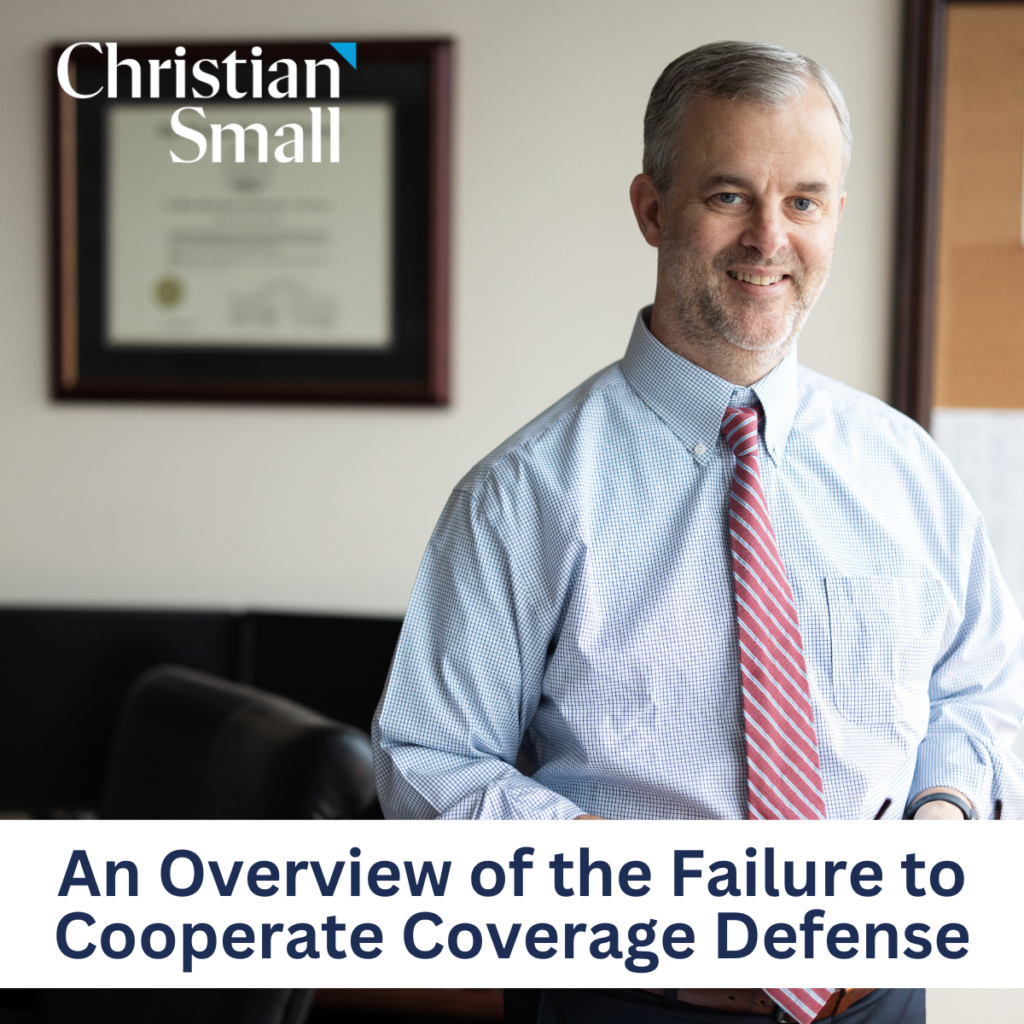
 With nearly 20 years of litigation experience in both state and federal courts in Alabama and more than 70 trials to verdict, it goes without saying that Jim Pattillo is comfortable in the courtroom. He focuses his practice on matters involving insurance coverage and bad faith liability, business and commercial litigation, and professional and product liability.
About Christian & Small
Christian & Small LLP represents a diverse clientele throughout Alabama, the Southeast, and the nation with clients ranging from individuals and closely held businesses to Fortune 500 corporations. By matching highly experienced lawyers with specific client needs, Christian & Small develops innovative, effective, and efficient solutions for clients. With offices in Birmingham, metro-Jackson, Mississippi, and the Alabama Gulf Coast, Christian & Small focuses on the areas of litigation and business, is a member of the International Society of Primerus Law Firms, and is a Mansfield Rule™ Participating Law Firm. Our corporate social responsibility program is focused on education, and diversity is one of Christian & Small’s core values.
No representation is made that the quality of legal services to be performed is greater than the quality of legal services performed by other lawyers.