
• Home
  • The Firm
  • Services
    • Alternative Dispute Resolution
    • Appellate
    • Bankruptcy & Restructuring
    • Business Services and Commercial Litigation
    • Class Actions & Toxic Torts
    • Construction
    • E-Discovery and Cyber Security
    • Governmental Liability
    • Healthcare
    • Insurance
    • Labor and Employment
    • Product Liability
    • Professional Liability
    • Real Estate
    • Retail and Hospitality
    • Transportation
  • People
  • News
  • Nonstop Advocates
  • OFFICES
    • BIRMINGHAM METRO
    • JACKSON METRO
    • GULF COAST
  • Careers

About Create

Create is a multi-purpose WordPress theme that gives you the power to create many different styles of websites.

Christian Small

Christian Small

  communications@csattorneys.com
  • Facebook
  • Instagram
  • LinkedIn
  • Twitter
  • YouTube
  • Home
  • The Firm
  • Services
    • Alternative Dispute Resolution
    • Appellate
    • Bankruptcy & Restructuring
    • Business Services and Commercial Litigation
    • Class Actions & Toxic Torts
    • Construction
    • E-Discovery and Cyber Security
    • Governmental Liability
    • Healthcare
    • Insurance
    • Labor and Employment
    • Product Liability
    • Professional Liability
    • Real Estate
    • Retail and Hospitality
    • Transportation
  • People
  • News
  • Nonstop Advocates
  • OFFICES
    • BIRMINGHAM METRO
    • JACKSON METRO
    • GULF COAST
  • Careers

“You Keep Using That Word, I Do Not Think It Means What You Think It Means”

Author: Gaby E. Reeves | August 5, 2025By juliemLegal Topics
“You Keep Using That Word, I Do Not Think It Means What You Think It Means”juliem2025-08-06T14:40:36+00:00
“You Keep Using That Word, I Do Not Think It Means What You Think It Means”
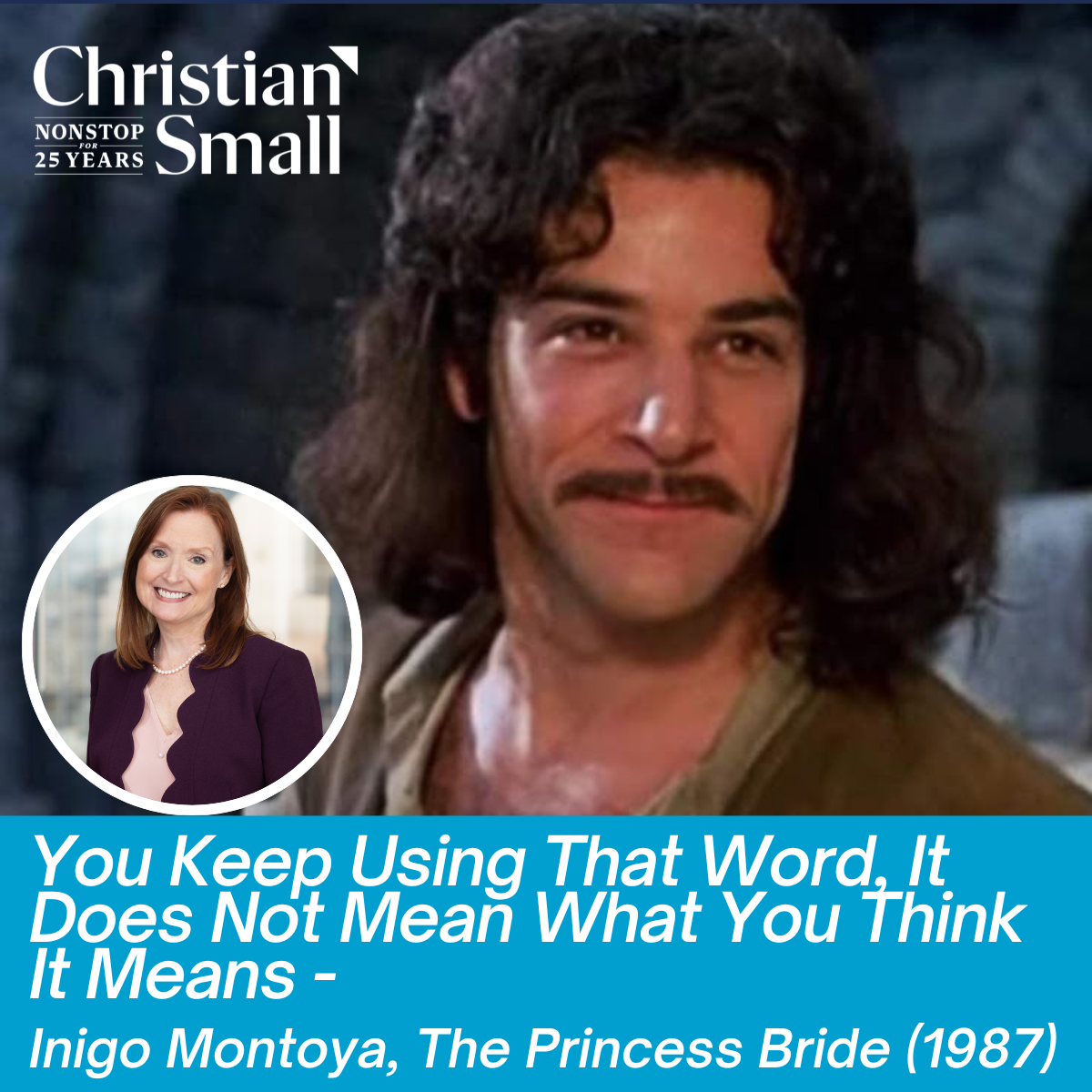
“You Keep Using That Word, I Do Not Think It Means What You Think It Means.”
—Inigo Montoya, The Princess Bride (1987)

This article reprinted with permission from AIM newsletter for its insureds. Issue No. 53 | June-July 2025.

In May, the Alabama Supreme Court addressed an issue of first impressions in Adams v. Atkinson: “what do the terms ‘indemnify’ and ‘hold harmless’ mean if they are split into separate contractual provisions?” Adams v. Atkinson, No. SC-2024-0528, 2025 Ala. LEXIS 53, at *11 (May 16, 2025). They did not mean what I thought they meant.

The case involved three different trust funds and two relevant agreements; one agreement was dated 2011 and the other, 2013. Adams paid the attorney’s fees of a bank trustee following the bank’s successful defense of a claim by Adams’ daughters (“Defendants” or “the defendants”) pursuant to a provision of the 2011 Agreement obligating her to do so. She then sued Defendants for reimbursement under the terms a provision of the 2013 Agreement entitled, “Hold Harmless Agreement,” (“hold harmless provision”), under which Defendants “agree[d] to hold [Adams]  … harmless against any claim … by any corporate trustee sued by … [Defendants] for attorneys’ fees incurred by such trustee in its successful defense of any [such] claim ….” Defendants argued that the “hold … harmless” language did not mean to “indemnify;” it simply meant that it would not hold Adams responsible if a corporate trustee successfully defended itself in a suit they initiated and later exercised its statutory right to reimbursement of attorney’s fees from the trust fund. The Jefferson County Circuit Court dismissed Adams’s claim and she appealed. The Supreme Court reversed and remanded.

The Supreme Court first noted that it had “encountered variations of the ‘indemnify and hold harmless’ doublet on a number of occasions” and “never noted a distinction between the terms.” It further stated that Alabama legal authorities similarly treat these terms as interchangeable, as do the majority of states. Thus, the Court concluded that “‘indemnify and hold harmless are perfectly synonymous.’” (Bryan A. Garner, Garner’s Dictionary of Legal Usage, p. 444 (3d ed. 2011) “For our purposes [in this lawsuit], a good working definition of ‘indemnify’ is ‘[t]o reimburse (another) for a loss suffered because of a third party’s or one’s own act or default.’” Black’s Law Dictionary 918 (11th ed. 2019) Commenting that it had never “squarely faced a case that hinged on” the particular meaning of “hold harmless,” the Court turned to the language of the 2013 Agreement.

The 2013 Agreement also included a provision entitled, “Indemnity” stating, “[Adams] shall indemnify [the defendants] from and against any damages suffered (‘Damages’) by [the defendants] as a result of any material breach of the … [2013] Agreement ….”  The Court said that, in this provision, the word “indemnify” took on its standard meaning. The language of the hold harmless provision stated that “[the defendants] agree to hold [Adams] … harmless against any claim, demand, action or liability ….” As the record before it did not indicate the parties used a “peculiar definition” of “hold harmless,” the Court assumed the parties also intended, for purposes of the 2013 Agreement,  for it to have its ordinary meaning, i.e., to “indemnify.”
It would appear that the term “hold harmless” is rendered obsolete and we can simply stop using the term “hold harmless” and replace it with “indemnify” from hereon out.  Not so fast. “There’s a big difference between ‘mostly dead’ and ‘dead.’” As long as there is a client who wants to protect itself from legal liability arising from a contract, “hold harmless” remains “slightly alive.” If you have such a client (you do), you should include a separate “hold harmless” provision in the contract. Keep it simple and address only the limitation of the client’s liability pursuant to applicable law. Do not include any terminology that suggests indemnity, e.g., damages, compensation, loss, etc. The purpose of a “hold harmless” provision is to prevent lawsuits from being filed against your client in the first place. Remember, the Adams Court says its holding is limited; the simple tenets of contract interpretation still apply, so say what you mean and say it succinctly.
The majority of contracts call for an indemnity provision. However, when you draft it, avoid terminology associated with “hold harmless” agreements, e.g., “legal liability” or “legal responsibility.” List the specific events that trigger and/or negate the agreement to indemnify. The purpose of an indemnification agreement is to ensure financial compensation for damages or legal costs, not to avoid lawsuits.
We all know too well that a person can incur damages even where no suit is filed. The higher the risk associated with the activity, the higher level of protection needed. In these cases, include both a distinct “hold harmless” and a distinct indemnification provision.  Avoid the universal, omnibus “hold harmless and indemnify” clause, if possible (and it is). “Combo-clauses” are wordy by nature and lend themselves to confusion. The holding in Adams stands to increase the risk of such “all-exclusive” clauses being labeled ambiguous and, as such, subject to court interpretation.
“Have fun stormin’ da castle!” — Miracle Max
Gaby E. Reeves has been practicing law since 1999. She is located in Christian & Small’s Mobile/Baldwin County office and focuses her practice on general civil litigation with a concentration in first-party insurance, personal injury and premises liability defense litigation. Her experience includes representing both corporations and individuals in trial and appellate work, and she holds an AV® Preeminent Peer Review Rating and an AV® Preeminent Judicial Division Rating from Martindale-Hubble.
About Christian & Small

Post navigation

← Jury Themes In Product Liability Trials: “What Did You Expect?” May Be Your Strongest Defense
When Software Fails Due to Configuration Errors: Defending Medical Software Developers Against Misplaced Liability →

Leave a Reply Cancel reply

You must be logged in to post a comment.

Archive

Categories

OFFICES

505 North 20th Street
Suite 1800 Financial Center
Birmingham, Alabama 35203
Tel: 205-795-6588
Fax: 205-328-7234


603 Duling Avenue
Suite 204
Jackson, MS 39216
Tel: 601-4270-4050
Fax: 601-707-7913


1 Timber Way
Suite 101
Daphne, AL 36527
Tel: 251.432.1600
Fax: 251.432.1700


No representation is made that the quality of legal services to be performed is greater than the quality of legal services performed by other lawyers.
© 2026 Christian Small All Rights Reserved.

Communications with us by email or through this website do not create an attorney-client relationship with us. Under no circumstances should you send confidential information to us without first speaking with a firm attorney about establishing an attorney-client relationship. Unless you are already a client, we may not be able to treat information that you provide as privileged, confidential, or protected, and we may be able to represent a party adverse to you using information that you have provided. Additionally, communication with the firm by email over the Internet may not be secure. By sending this email, you confirm that you have read and understand this notice.