

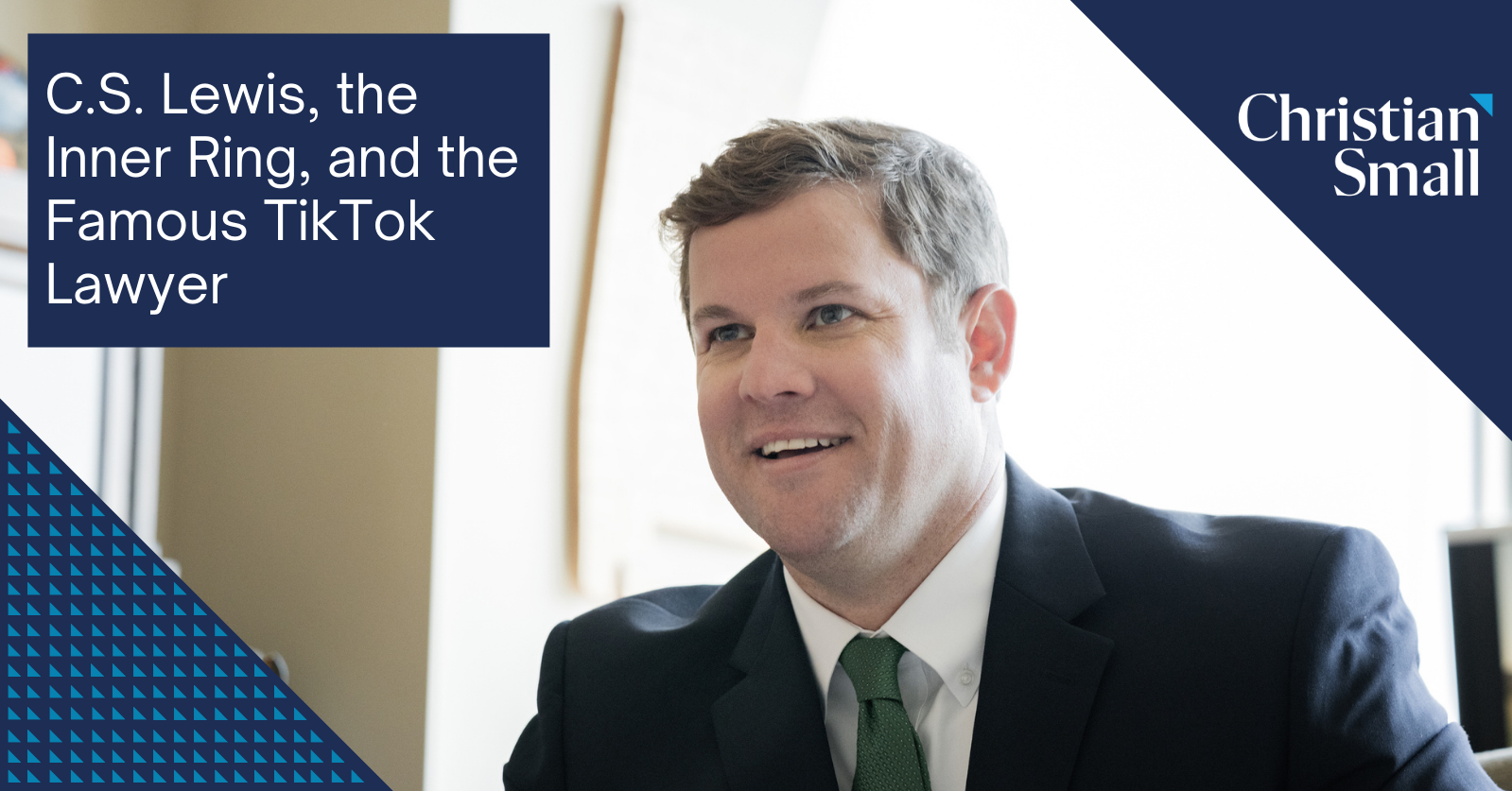
C.S. Lewis’ essay titled “The Inner Ring” addresses the human desire to be accepted within a group, and the misery of exclusion from a desirable group. For lawyers, Lewis’ Inner Ring might mean a “paid-for-most-awesome-lawyer-award”. It may mean getting into the partnership at your firm or snagging one of the four corner offices on your floor. It may even mean becoming a TikTok famous lawyer. Lewis observed that the desire for entrance into an Inner Ring can make a person say or do things the person would not otherwise say or do—compromise one’s authentic self or mask a self-serving motive. He also argues that when one finally gets into an Inner Ring, a desire inevitably arises for entry into yet another more exclusive Inner Ring. Lewis likens it to an onion—moving from one Inner Ring to another, peeling back the layers until nothing is left.
Although the desire to get into an Inner Ring is not necessarily wrong, Lewis cautions us to examine the desire drawing us into an Inner Ring. Are we aiming for the Inner Ring for the right reason, or are we simply serving our own ego, or white-washing our own insecurities? Rather than obsessing over entry into an exclusive group, obtaining an accolade, honorary plaque, or whatever other Inner Ring that is the focus of your current desire, Lewis suggests we simply focus on doing our work well:
If in your working hours you make the work your end, you will presently find yourself all unawares inside the only circle in your profession that really matters. You will be one of the sound craftsmen, and the other sound craftsmen will know it.
This advice may seem trite, naïve, or old-fashioned by today’s standards; particularly so in our era of social media influencers and self-promoters. Over the past six months or so, I have noticed lawyers cross-posting TikTok videos on LinkedIn. TikTok—a platform dominated by short videos of pranks, stunts, tricks, jokes, dances, and memes—has now given way to the TikTok famous lawyer. While the TikTok lawyer may achieve an Inner Ring of sorts (TikTok fame), a 60-second video tells me nothing about the lawyer’s “craftsmanship” as Lewis described it. Perhaps that’s not the point of TikTok or other similar social media platforms. Perhaps the point is to create the illusion of social proof with little to no actual craftsmanship to show for it. See Robert Caldini’s book Influence: The Psychology of Persuasion for more on social proof.
I don’t maintain an elitist or Luddite view of social media. It’s an important tool for networking, business development, and at times, learning. If you are a regular reader of my posts, you know I don’t have a philosophical objection to some self-promotion! However, Lewis’ essay helps me maintain focus on the craftsmanship of law rather than the meaningless Inner Ring of TikTok fame.
About Christian & Small
Christian & Small LLP represents a diverse clientele throughout Alabama, the Southeast, and the nation with clients ranging from individuals and closely-held businesses to Fortune 500 corporations. By matching highly experienced lawyers with specific client needs, Christian & Small develops innovative, effective, and efficient solutions for clients. With offices in Birmingham, metro-Jackson, Mississippi, and the Alabama Gulf Coast, Christian & Small focuses on the areas of litigation and business, is a member of the International Society of Primerus Law Firms, and is the only Alabama-based member firm in the Leadership Council on Legal Diversity. Our corporate social responsibility program is focused on education, and diversity is one of Christian & Small’s core values.
No representation is made that the quality of legal services to be performed is greater than the quality of legal services performed by other lawyers