

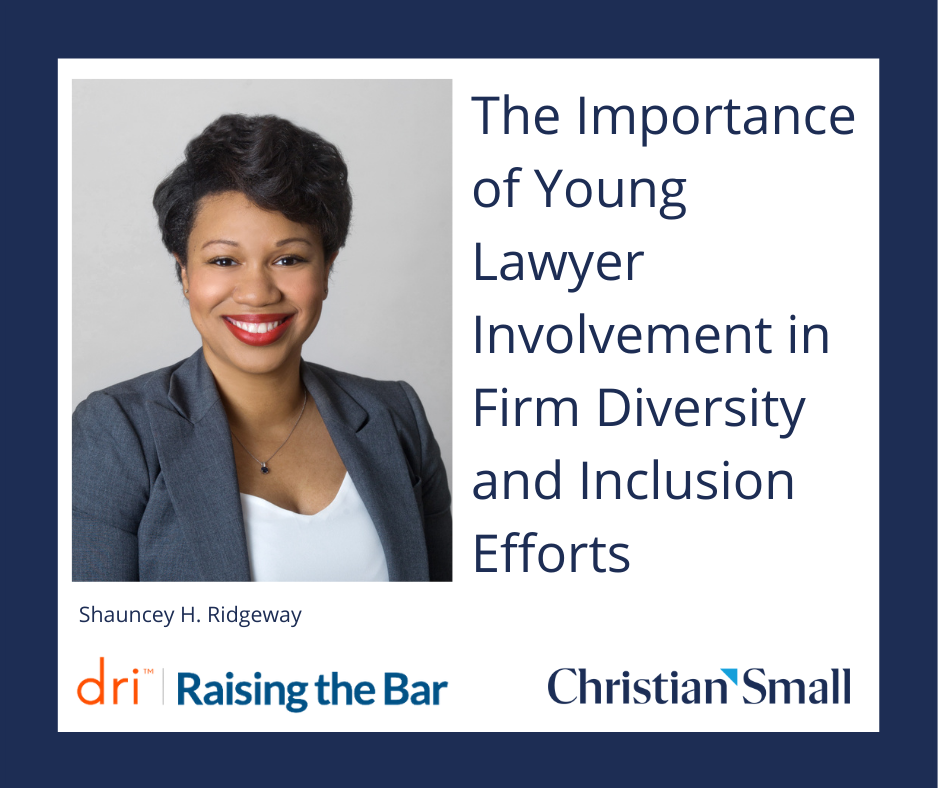
The following article was first published in the June 4, 2021 issue of DRI™ Raising the Bar. The article is authored by DRI™ member and Christian & Small associate Shauncey H. Ridgeway and DRI member Troy L. Bell.
Diversity Matters. Diversity must be a key initiative for any company to achieve and build sustainable success. Diversity can no longer be treated as a catchphrase and/or a buzzword, or tokenism. Events that transpired over the past 12 months have shined an even brighter light on the lack of diversity in the legal field. There have been no significant advancements in diversity throughout our profession. According to 2020 data presented by the American Bar Association, Black attorneys continue to make insignificant incremental gains. Black attorneys represent less than 10 percent of all practicing attorneys as partners in law firms, which represents only a 4 percent gain in over a decade. American Bar Association, ABA Profile of the Legal Profession 2020 (last visited April 27, 2021).
In addition, according to the National Association of Legal Placement’s (NALP) 2020 Report on Diversity in U.S. Law Firms, just 1 in 4 partners were women (25.05 percent) and people of color continue to fare worse. National Association for Law Placement, Inc., 2020 Report on Diversity in U.S. Law Firms (last visited April 27, 2021). The percentage of Black partners barely exceeded 2 percent, Latinx attorneys made up 2.80 percent of partners, and Asian lawyers made up 4.08 percent of partners. Id. These statistics show that people of color and women still significantly lag behind their counterparts and have made marginal progress in the legal profession.
The benefits of diversity are well-documented. In any industry, those companies that have embraced diversity are better positioned to achieve sustainable success. Research by McKinsey & Company has further shown that diverse companies are likely to substantially outperform less diverse competitors. Additionally, diverse law firms are better positioned to attract talented, open-minded attorneys. According to the American Bar Association, Gen X and Millennial attorneys desire “diverse and socially conscious firms” that embrace change, authenticity and inclusivity. Beth A. Wood & Lindsey Hills, Generation Gaps in Practice (last visited April 27, 2021).
Equally important to diversity is inclusion. It is not enough to employ attorneys with diversity of age, gender, race, and ethnicity. Without inclusion, firms will not be able to retain diverse individuals. An NALP study found that the attrition rate of diverse attorneys possesses an equal uphill battle as the average rate of minority attrition was 22 percent, compared to non-minorities at 17 percent. Debra Cassens Weiss, Law firms lost 15 associates for every 20 they hired, NALP Foundation study finds (last visited April 27, 2021). This speaks to a culture of conformity which eliminates the value of diversity. Finally, a law firm that embraces a diverse culture will be more attractive to diverse clients already moving in that direction. Developing a culture that embraces diversity and inclusion as a mirror image that reflects the values of their own organizations.
Why Should You Get Involved in Your Firm’s Diversity and Inclusion Efforts?
There are three reasons why diversity will be a critical factor to the growth of law firms.
- Innovation and financial growth. Where diversity is embraced, innovation will follow. Law firms that are more diverse are likely to include different voices that add unique perspectives, creative solutions, and strategic approaches to litigation. Innovative law firms will attract top talent, improve employee satisfaction, and excel at building client relationships. Therefore, these firms will enjoy a continual cycle of ever-increasing gains.
- Improve understanding of a client’s business and needs. Clients have many law firms to choose from. Increasingly, they are looking for law firms that are client focused and possess a diverse-centered philosophical approach to their business—meaning that a diverse team of attorneys are performing substantial work on their files. This is a critical factor because it eliminates any form of tokenism and is a key component in the growth and sustainability of true diversity in a law firm. Clients are increasingly aware that law firms that reflect their race, gender, age, sexual orientation, or culture are likely to create a cohesive approach to their needs. This can only be achieved through diversity.
- Diverse leadership correlates to profitability and value creation. According to a McKinsey & Company report, a linear relationship exists between racial and ethnic diversity and better financial performance. The report indicates that earnings before taxes and interest increase by 0.8 percent for every 10 percent increase in diversity at the senior executive level.
Vivian Hunt, Dennis Layton & Sara Prince, Why diversity matters (last visited April 27, 2021).
Additional research reported by Boston Consulting Group found that companies produce 45 percent higher innovation revenue than their competitors when they have a more diverse leadership team. Lorenzo, Voigt, Tsusaka, Krentz, and Abouzahr, How Diverse Leadership Teams Boost Innovation (last visited April 27, 2021). Because leadership establishes the culture of a firm, diversity in leadership can facilitate retention of diverse candidates by making equity and inclusion a strategic priority.
Why Is It Especially Important for Young Lawyers to Promote Diversity and Inclusion?
Diversity and inclusion efforts among younger attorneys, such as the DRI Young Lawyers Committee Diversity and Inclusion Subcommittee, are especially important. Young lawyer diversity efforts present the distinct opportunity to home in on the unique intersection of young and diverse lawyers. An abundance of statistics shows that while the median age for lawyers was 39 years old in 1980, the median age for lawyers today is 49 years old. Debra Cassens Weiss, As Fewer Law Grads Become Lawyers, The Profession Shows Its Age ABA Journal (last visited April 27, 2021). Today, 62 percent of lawyers are above the age of 45. Brandon Gaille, 330 Mind-Boggling Lawyer Demographics BrandonGaille.com (last visited April 27, 2021), com (last visited April 27, 2021). Only four percent of today’s practicing attorneys are under the age of 30. Id. This aging population of lawyers can be attributed, at least in part, to lawyers of the Baby Boomer generation continuing to practice law even as new attorneys become members of the bar.
But the youth (or lack thereof) of practicing attorneys is of significant importance. Statistics reflecting the makeup of the legal profession show that there is much work to be done in order for law firm makeup to better reflect the clients we serve and society as a whole.
This considered, young lawyer participation is desperately needed to bridge the diversity and inclusion gaps between younger and more seasoned attorneys. The burden of engaging in diversity and inclusion efforts does not rest solely on the shoulders of young lawyers. Still, young lawyers are best positioned to shape the future of their law firms. As young lawyers eventually take the place of their Baby Boomer counterparts, it is imperative that young lawyers actively engage in normalizing diversity and inclusion practices so that law firm diversity becomes commonplace.
How Can Young Lawyers Promote Firm Diversity Efforts?
Young lawyers often mistake that they lack the experience to affect change. However, the grassroots efforts of young lawyers in their everyday practices are what will take hold to effect broader change in the long term. A big part of diversifying law firms stems from attorney efforts to reach back to law students and new attorneys. Participation in firm recruitment efforts, mentoring law clerks, new associates, and volunteering with mock trial and moot court programs is key. Engaging in these activities ensures that law students and new attorneys alike who will come to comprise law firms will be encouraged to stick with the legal field by seeing and working with diverse attorneys.
Bringing informed ideas to firm diversity initiatives is also key to sustaining diversity and inclusion. Consequently, it is equally important to keep abreast of diversity and inclusion education. If there is to be a shift in the makeup of law firms, then the time for young lawyers to act is now. Everything that young lawyers do (or do not do) is consequential to sustaining diversity in the law in the long run. It is critical that young lawyers take hold of the everyday opportunities presented to them to promote inclusive diversity. So young lawyers heed the call: take ownership, take control, and take action towards shaping a more diverse and inclusive legal society.
 Troy L. Bell is an assocaite in Irwin Fritchie Urquart and Moore’s New Orleans, Louisiana officer where he focuses his practice on mass-tort litigation that involves medical device and pharmaceutical companies, toxic torts, product liability, personal injury, and class-action claims.
 Shauncey Hunter Ridgeway is an associate in the firm’s Jackson, Mississippi office where she focuses her practice on bankruptcy, creditor’s rights, real estate, insurance defense, and civil litigation.
About Christian & Small
Christian & Small LLP represents a diverse clientele throughout Alabama, the Southeast, and the nation with clients ranging from individuals and closely-held businesses to Fortune 500 corporations. By matching highly experienced lawyers with specific client needs, Christian & Small develops innovative, effective, and efficient solutions for clients. With offices in Birmingham, metro-Jackson, Mississippi, and the Alabama Gulf Coast, Christian & Small focuses on the areas of litigation and business, is a member of the International Society of Primerus Law Firms, and is the only Alabama-based member firm in the Leadership Council on Legal Diversity. Our corporate social responsibility program is focused on education, and diversity is one of Christian & Small’s core values.
No representation is made that the quality of legal services to be performed is greater than the quality of legal services performed by other lawyers.