

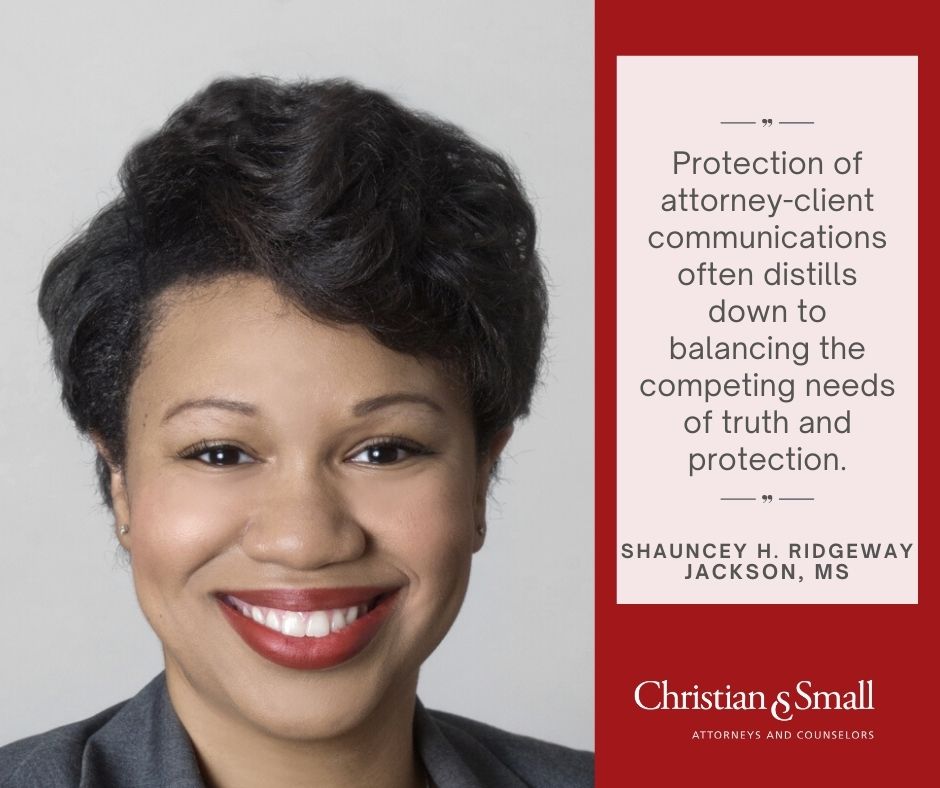
Shauncey Hunter Ridgeway wrote the following article for the Defense Research Institute’s publication For the Defense. To Be Privileged or Not to Be Privileged? That Is the Question.

We are all familiar with the protection of attorney-client privilege afforded by Federal Rule of Evidence (FRE) 502 and its varying kin throughout the states. But do these evidentiary rules unequivocally protect attorney-client communications and information? The short answer: Not always.
By nature, evidentiary rules that lend the protection of attorney-client privilege to certain information contradict the inherent utility of the discovery process as the fact-finding vehicle of litigation. Yes, the protection of attorney-client privilege is so valuable in the discovery process that Congress implemented FRE 502 in 2008 to strengthen the protections afforded to attorney-client privileged information and incorporate provisions that better safeguarded against the waiver of privilege through an inadvertent disclosure of otherwise privileged information. Thomas F. Munno & Benjamin R. Barnett, New Federal Rules of Evidence Arrives, Law.com (Dec. 1, 2008); see also Fed. R. Evid. 502. Nevertheless, both federal and state courts have narrowed the application of attorney-client privilege in ongoing efforts to balance parties’ competing needs for truth and protection.
One such instance of this delicate balancing act occurs when a party specifically places the attorney–client relationship squarely at issue and makes the attorney–client information essential to the outcome of the legal claims of the subject suit. See Metro. Life Ins. Co. v. Aetna Cas. & Sur. Co., 730 A.2d 51, 52-53 (Conn. 1999) (“Because of the important public policy considerations that necessitated the creation of the attorney-client privilege, the ‘at issue,’ or implied waiver, the exception is invoked only when the contents of the legal advice is integral to the outcome of the legal claims of the action. Such is the case when a party specifically pleads reliance on an attorney’s advice as an element of a claim or defense[.]”). In the insurance context, specifically, the question of whether insurance companies waive attorney–client privilege arises when insurance companies assert that their coverage decisions and claims handling actions are reasonable based on the advice of legal counsel. Whether this type of defense destroys the applicable attorney–client privilege depends on the jurisdiction where the case is pending.
On the one hand, some courts treat insurance company defenses that assert reasonableness based on the advice of counsel as an implied waiver of attorney–client privilege. These courts reason that such defenses put the information obtained from counsel front and center in determining whether the insurance company’s actions were reasonable. As the Arizona Supreme Court reasoned:
A litigant cannot assert a defense based on the contention that it acted reasonably because of what it did to educate itself about the law when its investigation of and knowledge about the law included information it obtained from its lawyer, and then use the privilege to preclude the other party from ascertaining what it actually learned and knew.
State Farm Mutual Auto. Ins. Co. v. Lee, 13 P.3d 1169, 1177 (Ariz. 2000). Other courts have adopted similar stances where the claims adjuster’s knowledge of the law and ultimate coverage decision turns entirely on the advice of counsel. See, e.g., Dakota, Minn. & E. R.R. Corp. v. Acuity, 771 N.W.2d 623, 638 (S.D. 2009) (holding that “where an insurer unequivocally delegates its initial claims function and relies exclusively upon outside counsel to conduct the investigation and determination of coverage, the attorney-client privilege does not protect such communications”); Mission Nat’l Ins. Co. v. Lilly, 112 F.R.D. 160, 163 (D. Minn. 1986) (“To the extent that [counsel] acted as claims adjusters, then, their work-product, communications to client, and impressions about the facts will be treated herein as the ordinary business of [the insurer], outside the scope of the asserted privileges.”); see also Travelers Prop. Cas. Co. of Am. v. 100 Renaissance, LLC, No. 2019-IA-00586-SCT, 2020 Miss. LEXIS 409, 2020 WL 6342790 (Oct. 29, 2020) (collecting cases on point and adopting the minority rule of waiver of attorney-client privilege).
On the other hand, a majority of courts take the position that insurance companies and their adjusters should be free to seek legal advice without the fear of potentially having to disclose such communications to the insured later in litigation. Indeed, the Court of Appeals of California observed,
A contrary rule would have a chilling effect on an insurance company’s decision to seek legal advice regarding close coverage questions and would disserve the primary purpose of the attorney-client privilege—to facilitate the uninhibited flow of information between a lawyer and client so as to lead to an accurate ascertainment and enforcement of rights.
Aetna Cas. & Sur. Co. v. Superior Ct., 200 Cal. Rptr. 471, 475 (Cal. Ct. App. 1984). See also Spiniello Cos. v. Hartford Fire Ins. Co., Civil Action No. 07-cv-2689 (DMC), 2008 U.S. Dist. LEXIS 53509, 19, 2008 WL 2775643 (D.N.J. July 14, 2008) (collecting cases setting out the majority rule and adopting a case-by-case approach); Steven Plitt, The Elastic Contours of Attorney-Client Privilege and Waiver in the Context of Insurance Company Bad Faith: There’s a Chill in the Air, 34 Seton Hall L. Rev. 513, 572 (2004). Courts taking positions similar to the Court of Appeals of California’s position also point out that the relevance and helpfulness of attorney–client communications do not implicate a per se waiver of the privilege. See, e.g., In re Burlington N., Inc., 822 F.2d 518, 533 (5th Cir. 1987) (“Attorney/client documents may be quite helpful in making out a claim of sham, but this is not a sufficient basis for abrogating the privilege.”); Rhone-Poulenc Rorer Inc. v. Home Indem. Co., 32 F.3d 851, 864 (3d Cir. 1994) (“Relevance is not the standard for determining whether or not evidence should be protected from disclosure as privileged, and that remains the case even if one might conclude the facts to be disclosed are vital, highly probative, directly relevant or even go to the heart of an issue.”).
Perhaps not surprisingly, whether attorney–client privilege actually protects the disclosure of certain information is consistent with the unwritten golden rule for analyzing and answering any legal question: it depends. In evaluating whether attorney–client privilege is a viable defense for insurance companies, it is worth considering whether the available jurisprudence pre-dates the most current version of the applicable evidentiary rules and whether the two can be reconciled in favor of retaining attorney-client privilege. Nevertheless, one thing remains constant, no matter how murky the waters surrounding the question of waiver of the attorney-client privilege may get in the insurance context—defense attorneys and in-house counsel alike should always act with the reasonable diligence and zeal in advising insurance companies necessary to effectuate the attorney-client relationship competently, regardless of whether they will enjoy the protections afforded by the attorney-client privilege.
About Christian & Small
Christian & Small LLP represents a diverse clientele throughout Alabama, the Southeast, and the nation with clients ranging from individuals and closely-held businesses to Fortune 500 corporations. By matching highly experienced lawyers with specific client needs, Christian & Small develops innovative, effective, and efficient solutions for clients. With offices in Birmingham, metro-Jackson, Mississippi, and the Alabama Gulf Coast, Christian & Small focuses on the areas of litigation and business, is a member of the International Society of Primerus Law Firms, and is the only Alabama-based member firm in the Leadership Council on Legal Diversity. Our corporate social responsibility program is focused on education, and diversity is one of Christian & Small’s core values.
No representation is made that the quality of legal services to be performed is greater than the quality of legal services performed by other lawyers.